
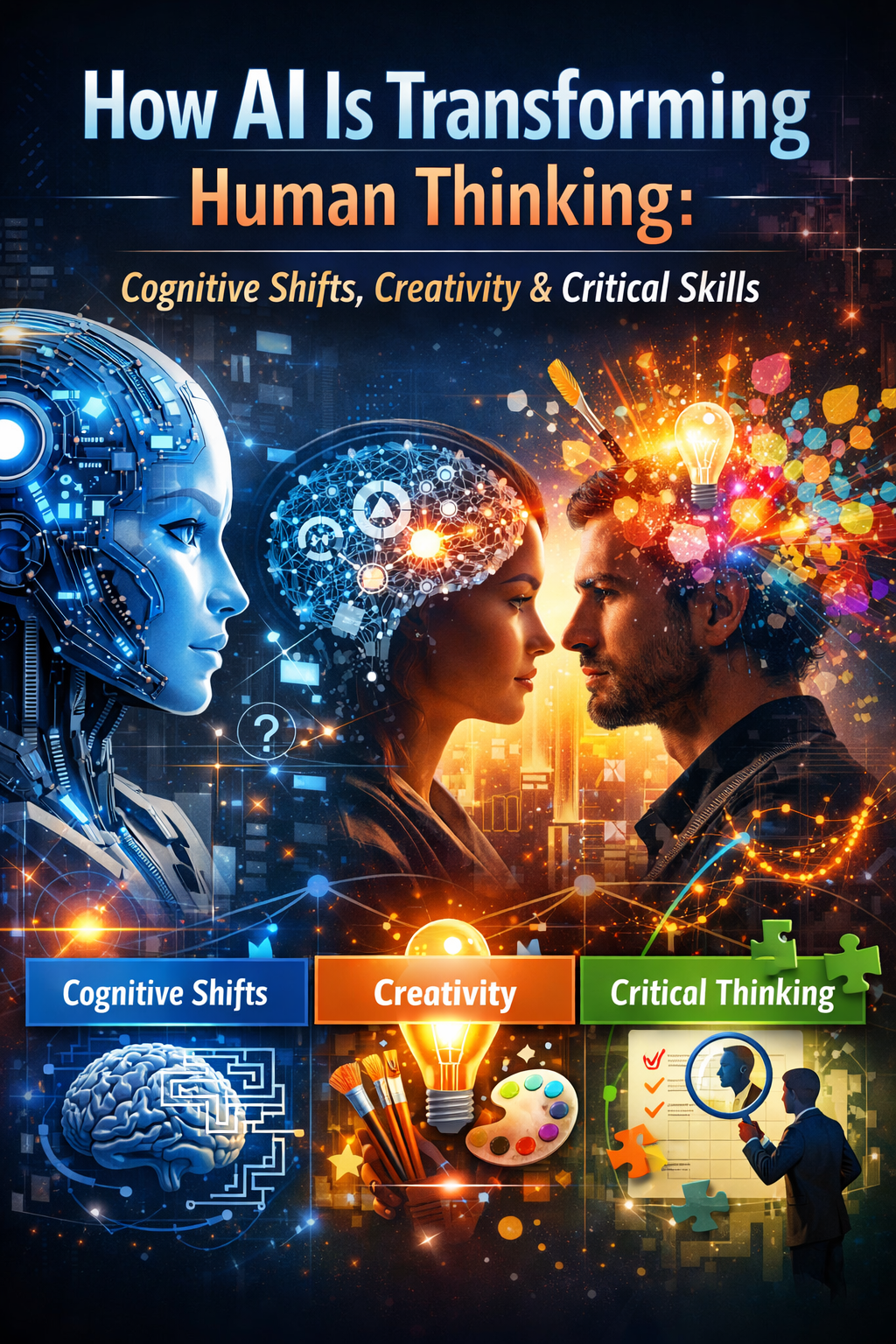
Artificial intelligence has transformed how humans access and process information. Instead of memorizing facts or manually searching through sources, individuals increasingly rely on AI systems to retrieve, summarize, and analyse data. This transition represents a fundamental cognitive shift—from internal information storage to external cognitive delegation.
Researchers describe this phenomenon as cognitive offloading, where mental tasks are transferred to external tools to reduce cognitive load and improve efficiency. With AI systems such as OpenAI models and tools developed by Google DeepMind, information retrieval has evolved from searching to synthesizing.
What Is Cognitive Offloading?
Cognitive offloading refers to the process of using external tools to handle memory, computation, or decision-support tasks that were previously managed by the brain.
Instead of remembering directions, dates, or large volumes of information, people now rely on digital systems. AI amplifies this shift by performing higher-order tasks such as summarization, translation, content generation, and predictive analysis.
Examples of Cognitive Offloading in the AI Era:
- Using AI to summarize long reports instead of reading them fully
- Relying on recommendation algorithms for decision-making
- Delegating writing drafts to generative AI systems
- Using predictive text rather than composing sentences independently
- Asking AI for explanations instead of researching multiple sources
This reduces mental strain but also alters how the brain encodes and retrieves information.
Digital Memory vs Biological Memory:
Human memory relies on neural encoding, repetition, and retrieval practice. AI systems function differently—storing vast datasets externally and retrieving them instantly when prompted.
Key differences include:
- Biological Memory: Limited capacity, strengthened through active recall
- Digital Memory: Vast storage, immediate retrieval
- Human Recall: Context-driven and associative
- AI Retrieval: Pattern-based and probabilistic
Research on “digital amnesia” suggests that when individuals know information is easily accessible online, they are less likely to retain it internally. This does not necessarily reduce intelligence but changes how memory is prioritized.
The Rise of “AI-Extended Cognition”:

Modern cognitive science increasingly views technology as part of an extended cognitive system. AI tools are becoming cognitive partners rather than mere utilities.
This shift includes:
- Collaborative problem-solving between humans and AI
- Real-time feedback loops improving idea refinement
- AI-assisted brainstorming enhancing creativity
- Data-driven augmentation of human reasoning
- Reduced emphasis on memorization, increased focus on interpretation
The concept of “extended cognition” suggests that thinking now occurs across both biological and digital systems.
Definition Table: Core Terms:
| Term | Definition | Relevance to AI |
| Cognitive Offloading | Delegating mental tasks to external tools | AI automates memory and analysis tasks |
| Digital Amnesia | Reduced memory retention due to reliance on devices | AI accelerates information outsourcing |
| Extended Cognition | Theory that tools become part of thinking systems | AI acts as cognitive collaborator |
Summary:
AI is shifting human thinking from memorization and manual retrieval toward cognitive offloading. By delegating tasks to intelligent systems, individuals reduce cognitive load but increasingly integrate AI into their thinking processes. This transformation reshapes memory, learning, and problem-solving frameworks.
also read: What Is Inflation?
Key Takeaways:
- AI reduces reliance on internal memory through cognitive offloading.
- Digital tools reshape how information is encoded and recalled.
- Extended cognition positions AI as a thinking partner.
- The shift prioritizes interpretation over memorization.
Common Misconceptions:
Myth: Cognitive offloading makes humans less intelligent.
Reality: It changes cognitive strategy, not necessarily intelligence.
Myth: Memory is becoming obsolete.
Reality: Memory remains essential for critical thinking and contextual understanding.
AI and Critical Thinking — Enhancement or Erosion?
One of the most debated questions in the AI era is whether artificial intelligence strengthens or weakens human critical thinking. As AI systems increasingly assist with analysis, writing, coding, and decision-making, concerns arise about automation bias and passive acceptance. At the same time, AI can enhance reasoning by expanding access to information and enabling deeper exploration of complex topics.
Institutions such as Stanford Human-Centered AI Institute and MIT Media Lab have emphasized that the impact of AI on thinking depends largely on how humans engage with these systems—passively or critically.
Automation Bias Explained:
Automation bias occurs when individuals over-trust automated systems, even when those systems may be incorrect.
In AI-assisted environments, this can manifest as:
- Accepting AI-generated answers without verification
- Assuming algorithmic outputs are inherently objective
- Reducing independent evaluation of evidence
- Deferring decisions to predictive systems
- Ignoring contradictory information
This bias can weaken analytical rigor if users stop questioning outputs. The risk increases when AI tools are perceived as authoritative or highly accurate.
When AI Improves Analytical Thinking:
Used actively, AI can enhance critical thinking rather than erode it.
AI strengthens analysis when individuals:
- Use it to compare multiple perspectives
- Ask follow-up questions to test assumptions
- Request counterarguments or alternative explanations
- Analyze AI reasoning processes
- Combine AI insights with domain expertise
In this collaborative model, AI becomes a cognitive amplifier—expanding reasoning capacity rather than replacing it.
Risks of Passive Acceptance:
Critical thinking declines when AI use becomes passive. Risks include:
- Surface-level understanding of complex issues
- Reduced problem-solving persistence
- Dependency on instant answers
- Decreased tolerance for ambiguity
- Lower engagement in deep research
Over time, habitual reliance without scrutiny may reduce cognitive resilience and analytical independence.
AI and Critical Thinking Comparison Table:
| Cognitive Behavior | Passive AI Use | Active AI Use |
| Information Review | Accepts output as final | Verifies and cross-checks |
| Problem-Solving | Delegates entirely | Uses AI as support tool |
| Perspective Taking | Limited to AI framing | Requests alternative viewpoints |
| Analytical Depth | Shallow processing | Deep evaluation and synthesis |
| Outcome | Reduced critical engagement | Enhanced reasoning capacity |
Summary:
AI can either enhance or erode critical thinking depending on usage patterns. Automation bias and passive acceptance pose risks, while active engagement—questioning, verifying, and synthesizing—can strengthen analytical skills. The determining factor is not the technology itself but human interaction with it.
Key Takeaways:
- Automation bias can reduce independent evaluation.
- AI enhances thinking when used as a collaborative tool.
- Passive reliance weakens analytical depth.
- Active engagement strengthens reasoning capacity.
Common Misconceptions:
Myth: AI automatically reduces critical thinking.
Reality: The impact depends on how individuals use and question AI systems.
Myth: AI-generated answers are always objective.
Reality: AI outputs reflect training data patterns and may contain bias or inaccuracies.
How AI Is Reshaping Attention and Focus:
Artificial intelligence systems increasingly shape how individuals allocate attention, consume information, and process tasks. Through recommendation engines, predictive notifications, and algorithm-driven feeds, AI influences what people see, when they see it, and how long they engage with it. This transformation has measurable effects on concentration, deep work capacity, and cognitive switching behavior.
Research in cognitive psychology suggests that constant digital stimulation increases attentional fragmentation and reduces sustained focus over time, particularly in environments dominated by algorithmic content delivery.
Algorithm-Driven Attention Loops:
AI-powered platforms optimize for engagement, not cognitive depth. Algorithms analyze behavior patterns and deliver personalized content designed to maintain attention.
Common mechanisms include:
- Personalized news feeds and video recommendations
- Predictive notifications based on user activity
- Infinite scroll design
- Behavioral reinforcement through likes and shares
- Real-time content adaptation
These systems create feedback loops where attention is continuously redirected, reducing uninterrupted cognitive processing.
Reduced Deep Work Capacity:
Deep work refers to sustained, distraction-free focus on cognitively demanding tasks. AI-driven digital environments often compete with this form of concentration.
Impacts include:
- Increased task-switching frequency
- Shortened attention spans
- Reduced tolerance for complex material
- Dependence on summarized content
- Preference for rapid information over long-form analysis
Cognitive load increases when individuals frequently shift between tasks, leading to mental fatigue and reduced productivity.
Multitasking and Cognitive Switching Costs:
AI-assisted multitasking tools can improve efficiency but also increase switching costs. Each shift between tasks requires mental reorientation, consuming cognitive resources.
Key effects include:
- Slower completion of complex tasks
- Higher error rates
- Reduced memory retention
- Mental exhaustion
- Lower creative problem-solving capacity
While AI automates certain processes, excessive multitasking diminishes the quality of human attention.
Attention Impact Table:
| Attention Factor | AI Influence | Cognitive Outcome |
| Content Consumption | Personalized algorithms | Fragmented focus |
| Task Switching | Notifications and multitasking tools | Increased cognitive load |
| Deep Work | Constant digital interruptions | Reduced sustained attention |
| Information Processing | Summarization tools | Faster intake, lower depth |
Summary:
AI reshapes attention by personalizing content, increasing multitasking, and reducing sustained focus. While these systems improve efficiency and accessibility, they also contribute to fragmented attention and decreased deep work capacity. Managing AI-driven environments is essential to preserve cognitive depth.
Key Takeaways:
- Algorithmic systems shape what captures human attention.
- AI-driven multitasking increases cognitive switching costs.
- Deep work capacity declines in high-interruption environments.
- Balanced AI use supports efficiency without sacrificing focus.
Common Misconceptions:
Myth: AI always improves productivity.
Reality: Without structured use, AI can increase distraction and reduce focus.
Myth: Multitasking is a skill enhanced by technology.
Reality: Frequent task-switching reduces cognitive performance and memory retention.
Creativity in the Age of Generative AI:
Generative AI has transformed how ideas are produced, refined, and distributed. Tools powered by large language models and image-generation systems can draft essays, compose music, design visuals, and brainstorm concepts within seconds. Platforms such as OpenAI and Anthropic have accelerated the integration of AI into creative workflows, raising a key question: Is AI enhancing creativity—or replacing it?
Rather than eliminating creativity, AI appears to be reshaping it. The role of the human creator is shifting from sole originator to director, curator, and editor of machine-assisted output.
AI as a Creative Partner:
AI can function as a collaborative ideation tool rather than a replacement for human imagination.
Ways AI enhances creativity include:
- Generating multiple idea variations instantly
- Breaking creative blocks through prompts
- Providing structural templates
- Offering stylistic experimentation
- Accelerating prototyping and drafts
In this model, AI expands the possibility space, allowing creators to explore more directions in less time. The human remains responsible for judgment, refinement, and meaning-making.
Idea Generation vs Idea Ownership:
One major shift lies in how ideas are generated and attributed.
AI-generated ideas:
- Derived from learned patterns across large datasets
- Statistically probable combinations
- Rapid and scalable
Human-generated ideas:
- Rooted in lived experience and emotional context
- Influenced by personal insight and subjective interpretation
- Often nonlinear and abstract
The distinction is not about originality alone but about intentionality. Humans decide what to keep, discard, refine, or transform. Creativity becomes less about producing raw material and more about curating and synthesizing it.
Does AI Reduce Original Thought?
Concerns exist that reliance on generative tools may standardize expression or reduce deep creative struggle. Risks include:
- Homogenized writing styles
- Reduced experimentation effort
- Overreliance on template-based thinking
- Diminished tolerance for creative uncertainty
- Shortcut-driven ideation
However, when used intentionally, AI can actually increase originality by:
- Encouraging cross-domain exploration
- Challenging assumptions through alternative outputs
- Speeding up iteration cycles
- Enabling rapid testing of unconventional ideas
The cognitive shift is not from creativity to passivity—but from effort-based generation to judgment-based refinement.
Creativity Comparison Table:
| Dimension | Human-Only Creativity | AI-Assisted Creativity | Hybrid Outcome |
| Idea Speed | Slower | Instant generation | Rapid iteration |
| Emotional Depth | High | Limited | Human-curated meaning |
| Exploration Range | Limited by time | Vast combinational output | Expanded creative field |
| Originality Risk | Unique but narrow | Pattern-based | Selective innovation |
| Control | Full authorship | Shared generation | Human-directed creativity |
Summary:
Generative AI transforms creativity from manual production to collaborative refinement. While risks of homogenization and overreliance exist, intentional AI use can expand ideation, accelerate experimentation, and enhance innovation. The future of creativity lies in human judgment guiding machine-generated possibilities.
Key Takeaways:
- AI acts as a creative accelerator rather than a replacement.
- Creativity shifts from generation to curation and refinement.
- Risks include homogenization and passive reliance.
- Strategic use expands idea diversity and experimentation.
Common Misconceptions:
Myth: AI is replacing human creativity.
Reality: AI generates patterns; humans provide meaning, direction, and evaluation.
Myth: Faster idea generation reduces originality.
Reality: Speed increases variation, but originality depends on human selection and transformation.
Decision-Making in an AI-Supported World:
Artificial intelligence increasingly influences how individuals and organizations make decisions. From financial forecasting to medical diagnostics and hiring recommendations, AI systems analyze large datasets to generate predictions and risk assessments. Institutions such as World Economic Forum and OECD have documented the rapid integration of AI into strategic and operational decision-making processes.
This shift changes the cognitive role of humans—from primary decision-makers to evaluators of algorithmic outputs. The central question is not whether AI makes decisions, but how humans interpret and validate those decisions.
Data-Driven Decisions:
AI enhances decision-making by identifying patterns beyond human cognitive capacity.
Key advantages include:
- Processing large-scale datasets rapidly
- Detecting correlations invisible to manual analysis
- Reducing emotional bias in structured contexts
- Providing predictive modeling and risk scoring
- Supporting evidence-based policy and business strategies
In high-data environments, AI improves efficiency and consistency, particularly in finance, logistics, and healthcare diagnostics.
Overreliance on Predictive Systems:
Despite benefits, excessive reliance on AI can introduce cognitive and systemic risks.
Potential drawbacks include:
- Blind trust in algorithmic recommendations
- Reduced human accountability
- Reinforcement of hidden data biases
- Diminished contextual judgment
- Lower tolerance for uncertainty
This phenomenon is linked to automation bias, where users defer to AI outputs even when contradictory evidence exists.
Human Judgment vs Algorithmic Output:
Human cognition and AI systems possess complementary strengths. Effective decision-making emerges from integration rather than replacement.
Human Strengths:
- Ethical reasoning
- Contextual interpretation
- Moral accountability
- Emotional intelligence
- Adaptive thinking in novel situations
AI Strengths:
- Data scalability
- Pattern detection
- Predictive accuracy in structured domains
- Consistency across repetitive tasks
- Real-time analytics
The optimal model is hybrid decision-making—where AI informs and humans evaluate.
Decision-Making Comparison Table:
| Decision Factor | Human Cognition | AI Systems | Hybrid Advantage |
| Data Volume | Limited | Massive | Balanced insight |
| Emotional Context | Strong | Limited | Context-aware decisions |
| Bias Type | Cognitive bias | Data bias | Cross-verification |
| Speed | Moderate | Instant | Efficient validation |
| Accountability | Direct | Indirect | Human oversight |
Summary:
AI reshapes decision-making by introducing predictive analytics and large-scale data processing into everyday choices. While it enhances speed and accuracy, overreliance can reduce independent judgment. The most effective decisions arise from collaboration between human reasoning and algorithmic analysis.
Key Takeaways:
- AI improves data-driven decision efficiency.
- Overreliance increases automation bias risks.
- Human judgment remains essential for ethics and context.
- Hybrid models produce more balanced outcomes.
Common Misconceptions:
Myth: AI removes bias from decisions.
Reality: AI can inherit and amplify biases present in training data.
Myth: Faster decisions are always better decisions.
Reality: Speed must be balanced with ethical reasoning and contextual understanding.
AI’s Impact on Learning and Education:
Artificial intelligence is transforming how knowledge is delivered, consumed, and assessed. Educational systems increasingly integrate adaptive platforms, AI tutors, and automated feedback tools to personalize instruction and improve learning efficiency. Organizations such as OECD and UNESCO have examined how AI reshapes educational models, skill requirements, and student cognition.
The shift is not simply technological—it alters what students prioritize: memorization declines, while interpretation, evaluation, and prompt-based interaction increase.
Personalized Learning Systems:
AI-driven platforms adjust content based on performance data, learning pace, and comprehension gaps.
Core capabilities include:
- Adaptive quizzes tailored to individual progress
- Instant feedback on assignments
- AI tutoring for concept clarification
- Learning path customization
- Predictive analytics to identify struggling students
Personalization improves engagement and retention by aligning instruction with learner needs rather than standardized pacing.
Reduced Memorization Culture:
As AI tools provide instant answers and explanations, traditional memorization becomes less central.
Observable shifts include:
- Greater emphasis on conceptual understanding
- Less reliance on rote recall
- Increased use of AI for drafting and research support
- Reduced manual note memorization
- Higher priority on interpretation skills
However, foundational knowledge remains critical for evaluating AI outputs effectively. Without core understanding, students may struggle to detect inaccuracies or bias.
Skills That Matter in the AI Era:
Education is gradually pivoting toward skills that complement AI systems rather than compete with them.
Emerging priority skills include:
- Critical thinking and verification
- Prompt literacy and AI interaction skills
- Data interpretation
- Ethical reasoning
- Creativity and synthesis
- Independent problem-solving
Rather than replacing learning, AI shifts focus toward higher-order cognitive abilities.
Education Shift Table:
| Traditional Focus | AI-Era Focus | Why It Matters |
| Memorization | Interpretation | AI retrieves facts instantly |
| Standardized pace | Personalized pathways | Improves engagement |
| Manual drafting | AI-assisted drafting | Accelerates productivity |
| Individual study | Human–AI collaboration | Enhances exploration |
| Recall testing | Analytical evaluation | Supports critical thinking |
Summary:
AI reshapes education by enabling personalized learning, reducing memorization emphasis, and prioritizing analytical and verification skills. While AI enhances access and efficiency, foundational knowledge remains essential to maintain critical thinking and independent reasoning.
Key Takeaways:
- AI enables adaptive, personalized education models.
- Memorization is declining in importance relative to interpretation.
- Verification and critical thinking are increasingly essential.
- Human–AI collaboration defines modern learning environments.
Common Misconceptions:
Myth: AI eliminates the need for learning.
Reality: AI changes what and how we learn, but foundational knowledge remains crucial.
Myth: Personalized learning guarantees better outcomes.
Reality: Effectiveness depends on engagement, oversight, and curriculum design.
Psychological and Neurological Implications:
Artificial intelligence does not directly rewire the human brain, but repeated interaction with AI systems can influence cognitive habits, reward pathways, and neural adaptation over time. Research in cognitive neuroscience and human–computer interaction suggests that technology use can shape attention patterns, memory prioritization, and behavioral reinforcement mechanisms.
Institutions such as National Institute of Mental Health and Stanford Human-Centered AI Institute have explored how digital environments affect stress responses, attention control, and emotional regulation. The long-term impact depends on intensity, duration, and mode of engagement.
Neuroplasticity and Technology:
Neuroplasticity refers to the brain’s ability to reorganize itself by forming new neural connections. Repeated cognitive behaviors—such as constant digital interaction—can reinforce specific neural pathways.
Potential effects include:
- Strengthening rapid information scanning skills
- Reduced tolerance for prolonged concentration
- Increased dependence on external memory systems
- Faster pattern recognition in digital contexts
- Shift from recall-based to retrieval-based thinking
These adaptations do not necessarily reduce intelligence but may reallocate cognitive resources toward speed and filtering rather than deep processing.
Dopamine and Instant Answers:
AI tools provide immediate feedback and answers, which can activate reward pathways associated with dopamine release.
Behavioral implications include:
- Preference for quick solutions over prolonged problem-solving
- Reduced patience for ambiguity
- Increased reliance on external validation
- Habitual checking behaviors
- Reinforcement of instant-gratification cycles
Over time, this may influence motivation patterns, particularly in younger generations exposed to AI-driven digital systems early in development.
Long-Term Brain Adaptation:
Long-term cognitive adaptation depends on balanced AI usage. Excessive reliance may alter how individuals approach learning, problem-solving, and uncertainty.
Possible outcomes include:
- Reduced persistence in complex tasks
- Greater efficiency in information filtering
- Higher dependence on AI-assisted reasoning
- Improved multitasking in structured environments
- Potential decline in deep reflective thinking if underutilized
However, when AI is used strategically—combined with deliberate deep work and independent reasoning—the brain can adapt in ways that enhance both speed and critical depth.
Psychological Impact Table:
| Cognitive Area | AI Influence | Possible Outcome |
| Attention | Personalized content & instant answers | Fragmented focus or rapid filtering |
| Memory | External storage systems | Reduced recall, stronger retrieval skills |
| Motivation | Immediate feedback loops | Shortened patience span |
| Problem-Solving | AI assistance | Efficiency gain or reduced persistence |
| Learning Adaptation | Adaptive systems | Optimized pace or dependency risk |
Summary:
AI interaction influences psychological patterns and neural adaptation through neuroplasticity and reward mechanisms. While it enhances speed, pattern recognition, and filtering skills, excessive reliance may reduce persistence and deep cognitive engagement. Balanced use determines long-term cognitive outcomes.
Key Takeaways:
- Neuroplasticity allows the brain to adapt to AI-driven environments.
- Instant AI responses can reinforce dopamine-based reward cycles.
- Long-term effects depend on engagement quality and intensity.
- Strategic AI use supports efficiency without sacrificing depth.
Common Misconceptions:
Myth: AI permanently damages the brain.
Reality: The brain adapts to usage patterns; balanced engagement mitigates risks.
Myth: Faster thinking equals smarter thinking.
Reality: Speed must be balanced with reflection and critical evaluation.
Benefits vs Risks — A Comparative Analysis:
Artificial intelligence introduces both opportunities and challenges for human cognition, learning, and decision-making. While AI enhances efficiency, creativity, and access to information, it also carries risks of dependency, reduced attention, and automation bias. Understanding this balance is crucial for individuals, educators, and organizations aiming to harness AI responsibly.
This section provides a structured comparison of the cognitive, educational, and behavioral benefits against the potential risks associated with widespread AI integration.
Cognitive Benefits:
AI improves human cognition in multiple areas:
- Information Processing: Rapid analysis and synthesis of large datasets.
- Problem-Solving: Supports complex reasoning with predictive insights.
- Memory Offloading: Reduces cognitive load by externalizing information.
- Creativity Enhancement: Generates new ideas and cross-domain patterns.
- Decision Support: Data-driven recommendations improve accuracy and efficiency.
These benefits allow humans to focus on interpretation, judgment, and strategic thinking rather than repetitive or low-level tasks.
Cognitive Risks:
Potential cognitive risks arise when AI is overused or improperly integrated:
- Automation Bias: Blind trust in AI outputs reduces independent evaluation.
- Attention Fragmentation: Algorithmic feeds and notifications disrupt focus.
- Reduced Deep Work: Overreliance diminishes sustained concentration and persistence.
- Digital Amnesia: Dependence on AI for memory can weaken internal recall.
- Homogenization of Thought: Generative AI may standardize creative outputs.
Without conscious oversight, AI’s cognitive assistance can become cognitive dependency.
Benefits vs Risks Table:
| Area | Benefits | Risks | Notes |
| Memory & Learning | Offloads factual recall, accelerates study | Reduced retention, digital amnesia | Balance AI use with active recall |
| Decision-Making | Data-driven accuracy, predictive insights | Overreliance, automation bias | Human oversight essential |
| Creativity | Idea generation, rapid prototyping | Homogenization, passive reliance | Human curation required |
| Attention & Focus | Efficient multitasking, information filtering | Fragmentation, shallow work | Structured focus time mitigates risk |
| Productivity | Accelerates repetitive tasks | Reduced problem-solving persistence | Combine AI with critical evaluation |
Summary:
AI offers significant cognitive and productivity advantages but also presents risks to attention, memory, creativity, and critical thinking. The net effect depends on intentional, balanced engagement, human oversight, and structured interaction with AI tools.
Key Takeaways:
- AI accelerates information processing, creativity, and decision-making.
- Overreliance may lead to cognitive dependency and attention fragmentation.
- Structured, mindful AI use maximizes benefits while minimizing risks.
- Human judgment remains crucial in hybrid AI-human systems.
Common Misconceptions:
Myth: AI either helps or harms cognition universally.
Reality: The impact depends on usage patterns, task type, and engagement strategy.
Myth: Increased speed always improves productivity.
Reality: Efficiency gains can come at the cost of depth and critical thinking if not managed carefully.
The Future of Human Thinking in an AI-Integrated Society:
As AI becomes increasingly integrated into daily life, education, workplaces, and creative pursuits, human cognition is evolving to adapt alongside these technologies. The future of thinking will be defined not by the replacement of human intelligence, but by hybrid cognitive systems where humans and AI collaborate, complementing each other’s strengths and compensating for weaknesses.
Experts at Stanford Human-Centered AI Institute and MIT Media Lab emphasize that AI will continue to shape attention, memory, problem-solving, and decision-making, creating both opportunities and challenges for society.
Augmented Intelligence Model:
Augmented intelligence focuses on enhancing human capabilities rather than replacing them. Key principles include:
- Cognitive Amplification: AI extends human reasoning and memory.
- Decision Support: Humans retain final judgment while AI provides data insights.
- Efficiency and Accuracy: AI handles repetitive, high-volume tasks.
- Collaborative Creativity: Humans curate, AI generates options.
This model encourages humans to focus on interpretation, ethical judgment, and strategic thinking, while AI accelerates analysis and information processing.
Cognitive Collaboration:
The future will emphasize partnerships between human and machine cognition:
- Students using AI tutors to explore multiple problem-solving approaches
- Professionals leveraging AI to simulate complex business scenarios
- Researchers combining AI-generated insights with human critical evaluation
- Creative industries adopting AI as co-creator while humans direct and refine output
This hybrid approach encourages complementary skills, ensuring humans remain in control of reasoning and ethical evaluation.
Ethical and Autonomy Concerns:
With AI integrated into thinking, society must address critical ethical considerations:
- Dependency Risk: Excess reliance may weaken independent reasoning.
- Bias and Fairness: AI systems may perpetuate historical or algorithmic biases.
- Decision Transparency: Understanding AI recommendations is essential for accountability.
- Cognitive Autonomy: Maintaining human agency in thought processes is crucial.
Policymakers, educators, and organizations must establish frameworks that balance AI assistance with human oversight.
Future Cognition Table:
| Area | AI-Integrated Potential | Human Role | Key Consideration |
| Decision-Making | Predictive analytics & optimization | Final judgment & ethical review | Avoid overreliance |
| Creativity | Idea generation & simulation | Curation & refinement | Maintain originality |
| Learning | Personalized adaptive systems | Critical evaluation & comprehension | Prevent dependency |
| Attention & Focus | Distraction reduction tools | Deep work & prioritization | Balance engagement |
| Problem-Solving | Scenario modeling | Strategic synthesis | Preserve cognitive resilience |
Summary:
AI integration is reshaping human cognition toward hybrid intelligence, emphasizing collaboration, augmentation, and strategic oversight. Humans remain central in decision-making, ethical reasoning, and creative judgment, while AI amplifies processing speed, information access, and idea generation.
Key Takeaways:
- Future cognition will be human-AI hybrid, not AI replacement.
- Humans retain judgment, ethical oversight, and strategic thinking roles.
- Cognitive collaboration maximizes benefits while minimizing dependency risks.
- Society must address ethics, bias, and autonomy proactively.
Common Misconceptions:
Myth: AI will eventually replace human thinking.
Reality: AI enhances and augments human cognition, creating collaborative intelligence.
Myth: AI integration removes responsibility from humans.
Reality: Human oversight and accountability remain essential in all AI-assisted decisions.
How to Think Critically in the Age of AI:
In an AI-driven world, critical thinking has become more essential than ever. While AI can generate information, insights, and solutions, humans must evaluate, verify, and interpret these outputs to maintain intellectual autonomy. Developing critical thinking skills allows individuals to use AI as a tool for reasoning rather than a replacement for judgment.
Verification Skills:
To think critically, always verify AI-generated outputs:
- Cross-check facts with credible sources
- Identify potential bias in AI suggestions
- Evaluate the reasoning behind AI recommendations
- Confirm numerical data and statistics
- Question assumptions embedded in AI outputs
Verification prevents automation bias and ensures decisions remain evidence-based.
Prompt Literacy:
Understanding how to ask precise questions of AI improves reasoning:
- Use clear, specific prompts to guide AI responses
- Test multiple phrasing variations to assess consistency
- Ask AI for counterarguments or alternative perspectives
- Request sources or references when possible
- Refine prompts iteratively to achieve deeper insight
Prompt literacy transforms AI from a passive tool into an active partner in reasoning.
Independent Reasoning Frameworks:
Even with AI support, humans must maintain independent reasoning:
- Use AI outputs as input, not final conclusions
- Compare multiple AI-generated perspectives
- Apply ethical and contextual judgment to decisions
- Engage in reflective thinking before action
- Integrate AI insights with prior knowledge and experience
Independent frameworks prevent cognitive dependency and preserve analytical rigor.
Critical Thinking Checklist:
| Skill | Application with AI | Outcome |
| Verification | Cross-check AI outputs | Accurate, evidence-based decisions |
| Prompt Literacy | Ask clear, precise questions | Relevant and contextual AI responses |
| Counterargument Evaluation | Generate alternative perspectives | Reduces bias and overreliance |
| Reflective Judgment | Analyze AI suggestions before acting | Maintains human autonomy |
| Ethical Assessment | Consider fairness and impact | Responsible decision-making |
Summary Box:
Critical thinking in the AI era involves verifying outputs, mastering prompt literacy, and maintaining independent reasoning frameworks. AI can enhance cognition when humans actively evaluate and synthesize information rather than passively accept it.
Key Takeaways:
- Verification ensures AI outputs are reliable.
- Effective prompting improves AI-assisted reasoning.
- Independent frameworks preserve human judgment.
- Ethical evaluation remains central to responsible decision-making.
Common Misconceptions:
Myth: AI answers are always correct.
Reality: AI outputs reflect training data and patterns, which may include bias or error.
Myth: Using AI reduces the need for human reasoning.
Reality: Human evaluation and critical thinking are essential to interpret and act responsibly.
Conclusion:
Artificial intelligence is profoundly reshaping human thinking, learning, creativity, decision-making, and attention. From cognitive offloading to AI-assisted problem-solving, the integration of AI tools offers unprecedented opportunities to amplify human potential. However, these benefits come with risks—automation bias, fragmented attention, overreliance, and altered cognitive patterns.
The future of human cognition lies in hybrid intelligence, where humans retain judgment, ethical oversight, and reflective reasoning, while AI provides speed, scale, and analytical power. By cultivating critical thinking, verification skills, and responsible AI engagement, individuals and society can harness AI as a collaborator, not a replacement, ensuring cognitive growth, creativity, and strategic competence in an AI-integrated world.
FAQs:
1. How is AI changing the way humans think?
AI shifts cognition toward externalized memory, rapid data analysis, and AI-assisted decision-making, transforming attention, creativity, and problem-solving. Humans increasingly act as evaluators of AI outputs rather than sole originators of information.
2. Does using AI reduce critical thinking skills?
Not inherently. Critical thinking depends on how AI is used. Passive reliance can weaken reasoning, while active evaluation, verification, and synthesis can enhance analytical abilities.
3. What is cognitive offloading in the AI era?
Cognitive offloading occurs when humans delegate memory, calculation, or information-processing tasks to AI systems, reducing mental load but changing how knowledge is encoded and retrieved.
4. Can AI improve creativity?
Yes. AI serves as a creative partner, generating ideas and alternative solutions. Human oversight ensures originality, meaning-making, and ethical curation of outputs.
5. How does AI affect attention and focus?
AI-driven algorithms, notifications, and personalized content can fragment attention, reduce deep work capacity, and increase task-switching. Structured usage and mindfulness preserve sustained focus.
6. What skills are essential in the age of AI?
Key skills include verification, prompt literacy, independent reasoning, ethical evaluation, creativity, and adaptive problem-solving. These complement AI’s analytical and generative capabilities.
References / Citation List
- National Institute of Mental Health (NIMH). “Digital Technology and Cognitive Health.” https://www.nimh.nih.gov
- Stanford Human-Centered AI Institute. “AI and Human Cognition.” https://hai.stanford.edu